Hiring Licensed Pest Control Companies for Safe Home Protection
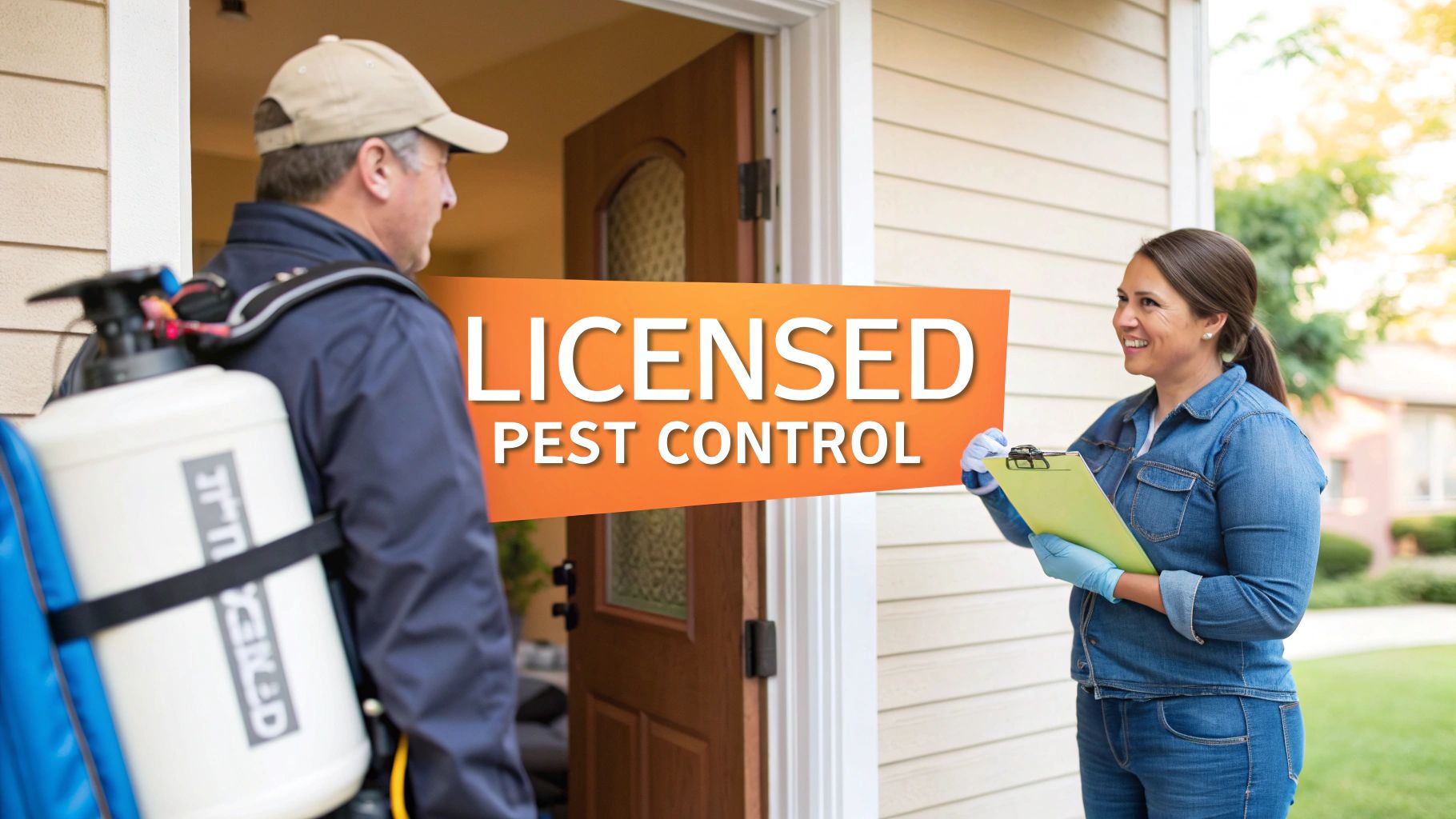
Think a cheaper exterminator is a good deal? Think again. It's a huge gamble. The real cost is not the initial price. It is what you pay for later. Unlicensed operators can cause serious problems for your home and family. The right choice is always a professional. For help finding one, you can always Call +1 855 224 3071.
The Real Risks of Unlicensed Pest Control
Look, I get it. You just want the bugs gone, and the lowest price seems like the fastest way to do it. But the gap between a licensed pro and some guy with a sprayer is massive. We're not just talking about whether the bugs come back; we're talking about the safety of your home, your family, and your wallet.
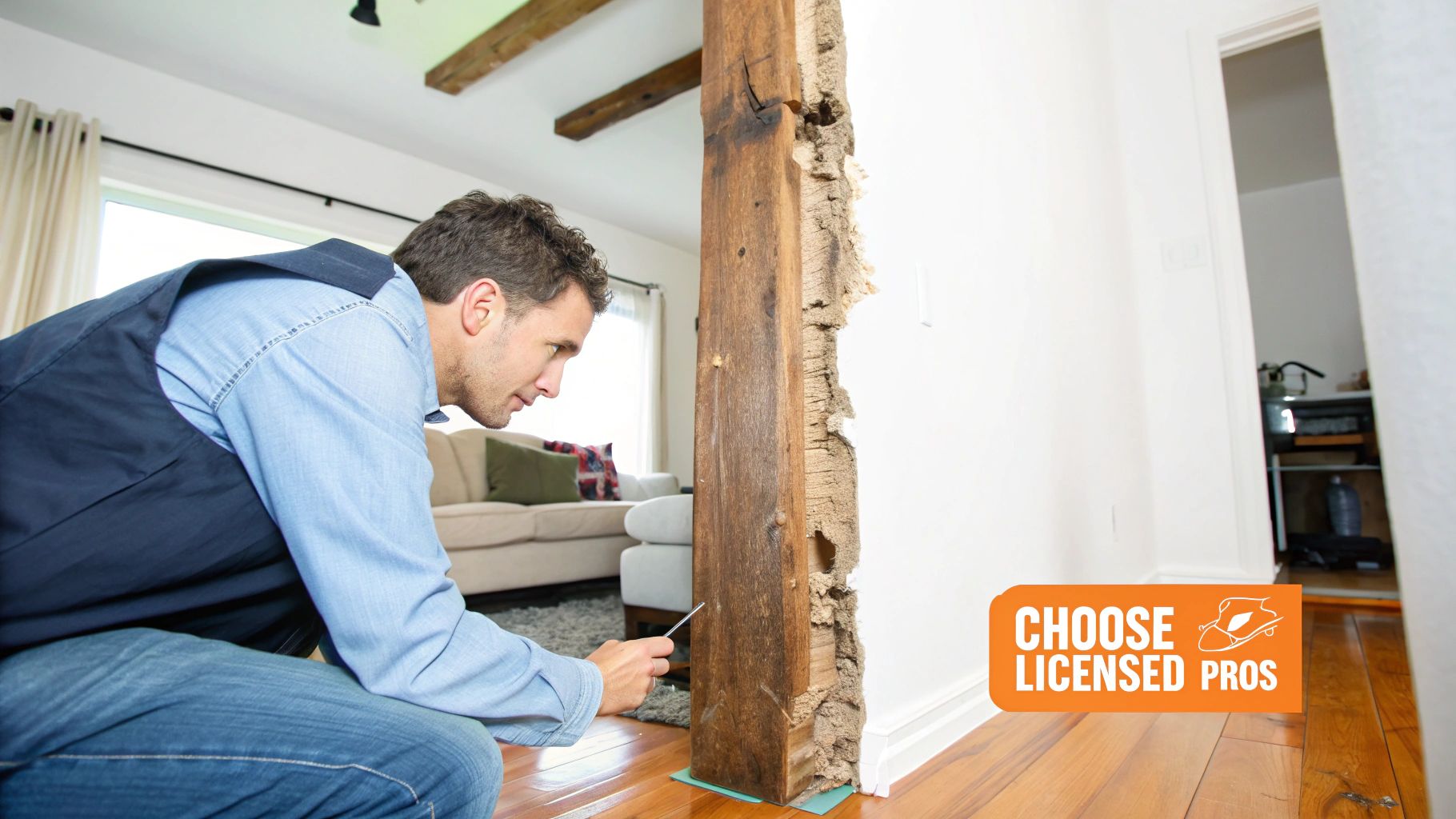
Unlicensed operators often have no clue how to properly identify pests or use chemicals safely. This leads to treatments that don't work, allowing silent destroyers like termites to keep chewing through your home's structure. Imagine thinking your termite problem is handled, only to find thousands of dollars in hidden wood damage a year later. It happens all the time.
Health and Financial Dangers
Even worse is the health risk. When someone uses unregulated chemicals or mixes them improperly, they're putting your family in danger. Without following strict EPA guidelines, these substances can cause serious respiratory issues or other health problems, especially for kids and pets. That's a risk no one should ever have to take.
If you have any concerns about what's being sprayed in your home, you need to talk to a real professional. You can Call +1 855 224 3071 for immediate, trustworthy advice from a verified expert.
Here's the other critical piece: accountability. Licensed pest control companies are required by law to carry liability insurance. This is your safety net. If a technician accidentally damages your property, you're covered. An unlicensed person? They offer zero protection, leaving you on the hook for their mistakes.
A license isn't just a piece of paper—it's your primary assurance of safety, competence, and financial protection. It proves the company has met state-mandated standards for knowledge, safety, and insurance.
Making the Right Choice
When you hire a licensed professional, you're hiring someone who's been vetted and is held to a high standard. They understand pest biology and use strategic, regulated methods that actually provide long-term solutions, not just a quick spray-and-pray fix.
- Proper Training: Licensed technicians get ongoing education on the latest—and safest—treatment methods.
- Accountability: They answer to state regulatory boards, which keeps them honest and ensures they follow industry best practices.
- Insurance Coverage: You are completely protected from financial liability if an accident happens during treatment.
Don't gamble with your home. The moment you see signs of an infestation, your first move should be to find a verified expert. For true peace of mind and a job done right the first time, Call +1 855 224 3071 to connect with a pre-screened, licensed pest control company in your area.
Understanding Pest Control Licenses and Credentials
Most people think a "license" is just a piece of paper that says a company can legally spray for bugs. It's not that simple. The truth is, a license is highly specific, and that's what protects you.
The company licensed to handle weeds in your lawn isn't necessarily qualified to eliminate the termites chewing through your home’s foundation. This is a critical difference. States issue different license categories to ensure the person showing up at your door has proven, tested knowledge for your exact pest problem.
It’s this expertise that drives the massive USD 25,621.8 million global pest control market, which is dominated by properly licensed pest control companies. With North America holding over 37% market share, you can see how important strict regulations are. You can get a closer look at the numbers by reviewing the full pest control market report.
If you’re ever confused about your state’s rules, Call +1 855 224 3071 for help cutting through the jargon.
What Different Licenses Mean for You
Think of it like this: you wouldn't go to a cardiologist for a broken foot. The same idea applies here. A company’s license must match your pest.
Here’s a quick breakdown of common license types:
- General Household Pest Control: This is the baseline for most residential services. It covers the usual suspects like ants, roaches, spiders, and silverfish.
- Wood-Destroying Organisms (WDO): This is a non-negotiable specialty license for anything that eats wood. If you have termites, carpenter ants, or powderpost beetles, the company must have this credential.
- Fumigation License: Tenting a home is a serious, complex job involving hazardous materials. This advanced license requires a much higher level of training and is absolutely mandatory for fumigation services.
- Public Health Pest Control: This license covers pests that are vectors for disease, like mosquitoes and ticks. It often involves large-scale or community-wide treatment plans.
The bottom line is simple: always ask a potential company what specific licenses they carry. A legitimate, licensed pest control company will be transparent and happy to prove their qualifications. If they get defensive, that’s a major red flag.
How to Verify a Company's Credentials
Never just take their word for it. Verification is a simple, quick step that gives you complete peace of mind.
Every state has a regulatory body—usually the Department of Agriculture or a similar board—that oversees pest control. They all maintain a public database of licensed applicators that you can search online. Just look up the company by name or license number.
This search will instantly tell you if their license is active, what categories they are certified in, and if there are any violations on their record. It’s the ultimate background check.
Many top-tier licensed pest control companies also follow advanced protocols. You can learn more about these smarter strategies in our guide on what is Integrated Pest Management.
Key Verification Checklist for Pest Control Companies
Here’s a quick reference table to make sure you’re checking all the right boxes before you hire anyone.
| Verification Point | What to Look For | Why It Matters |
|---|---|---|
| State License Status | Check the state’s official database for an “Active” status and the correct business name. | An inactive, suspended, or non-existent license means they are operating illegally and have no accountability. |
| License Categories | Ensure their license specifically covers your pest problem (e.g., WDO for termites). | The wrong license means they lack the certified knowledge to treat your issue effectively and safely. |
| Insurance Coverage | Ask for a Certificate of Insurance (COI) showing general liability and workers' comp. | This protects you from financial liability if a technician gets injured or damages your property. |
| Technician ID | The technician arriving should have a company ID with their name, photo, and license number. | This confirms the person at your door is a legitimate, certified employee of the company you hired. |
Following this checklist ensures you're working with a true professional, not just someone with a truck and a sprayer.
When the technician arrives, don't be shy about asking to see their official ID badge. A true professional expects it and respects your diligence. If you’re having trouble verifying a company’s status, Call +1 855 224 3071 and our team can assist you.
How to Find and Vet Reputable Pest Control Companies
Tossing "pest control near me" into Google feels like a good first step, but it's often the worst one. You're immediately hit with a wall of ads and slick websites that all promise the same thing, making it impossible to tell the pros from the pretenders.
This is exactly how people end up making rushed, bad decisions.
Instead of getting lost in the search results, you need a smarter plan. The trick is to start with sources that have already done some of the filtering for you, then follow up with a solid vetting process. This puts you in the driver's seat.
Start Your Search the Right Way
Don't just randomly pick names from a search page. Begin with organizations and local networks where a certain level of professionalism is already expected. This instantly weeds out the fly-by-night operators.
- National Pest Management Association (NPMA): This is my go-to starting point. The NPMA has a searchable database of member companies, and to be a member, you have to follow a strict code of ethics. It’s a huge head start.
- State and Local Agencies: Check your state’s Department of Agriculture or consumer protection agency. Their websites often have a list of licensed businesses and—more importantly—might show any public complaints or violations filed against them.
- Hyper-Local Recommendations: Jump on your local neighborhood Facebook or Nextdoor group. Ask for recommendations. People are brutally honest about who did a great job and who they'd never hire again. Real estate agents are also a goldmine for this kind of info.
Once you have a shortlist of three or four potential companies, it's time for the most crucial part: the vetting call.
If you want to skip the search and connect with a pre-screened expert, our team can help you find trusted pest control services near me. For immediate help, just call +1 855 224 3071.
The Vetting Call: Key Questions to Ask Every Company
The way a company handles your initial call tells you almost everything you need to know. Do they sound knowledgeable and patient, or are they just trying to get your credit card number? A key sign of a solid operation is their use of professional call handling services—it shows they invest in customer experience.
If anyone rushes you, dodges specific questions, or uses high-pressure sales tactics, hang up. They’re not the one.
Here are the questions that separate the real experts from the rest:
- "Can you describe your experience with [Your Specific Pest] in my neighborhood?" This is a test of local expertise. A true pro will know about common termite pressures in your county or the specific hiding spots for German roaches in local apartment buildings.
- "What's your approach to Integrated Pest Management (IPM)?" This is a big one. You're not looking for "we spray everywhere." The right answer involves inspection, monitoring, and using targeted, low-impact solutions first. Chemicals should be a last resort, not the first move.
- "Are your technicians licensed and insured? Can you send me proof?" The only acceptable answer is a fast and confident "yes." Don't be shy about asking for their state license number and a copy of their insurance certificate.
- "What, exactly, does your service guarantee cover?" Get the details. Does it include free re-treatments if the pests come back within 30 days? 60 days? Does it cover the specific pest you're dealing with? Get it in writing.
Vetting isn't about finding the cheapest quote; it's about finding the best value. A thorough, professional company might cost a bit more upfront but will save you a fortune in time, stress, and repeat treatments by solving the problem correctly the first time.
By asking these pointed questions, you'll quickly figure out who knows their stuff. This isn't a decision to rush.
Need a hand comparing your options or want to speak with a vetted pro right now? Call +1 855 224 3071.
How to Compare Quotes and Treatment Plans
Think the cheapest quote is the best deal? That’s almost never true.
In my experience, a suspiciously low price is a giant red flag. It usually points to a cheap, temporary spray that won’t solve the root problem, meaning you'll be paying again in a few months.
When you get quotes from licensed pest control companies, you aren't just buying a one-off service. You're investing in a professional diagnosis and a real strategy. It’s about long-term peace of mind, not just the initial price tag. If you're looking at a proposal and something feels off, Call +1 855 224 3071 for a no-obligation review.
Before you even start collecting quotes, make sure you're talking to legitimate pros. This simple flowchart breaks down exactly how to vet them.
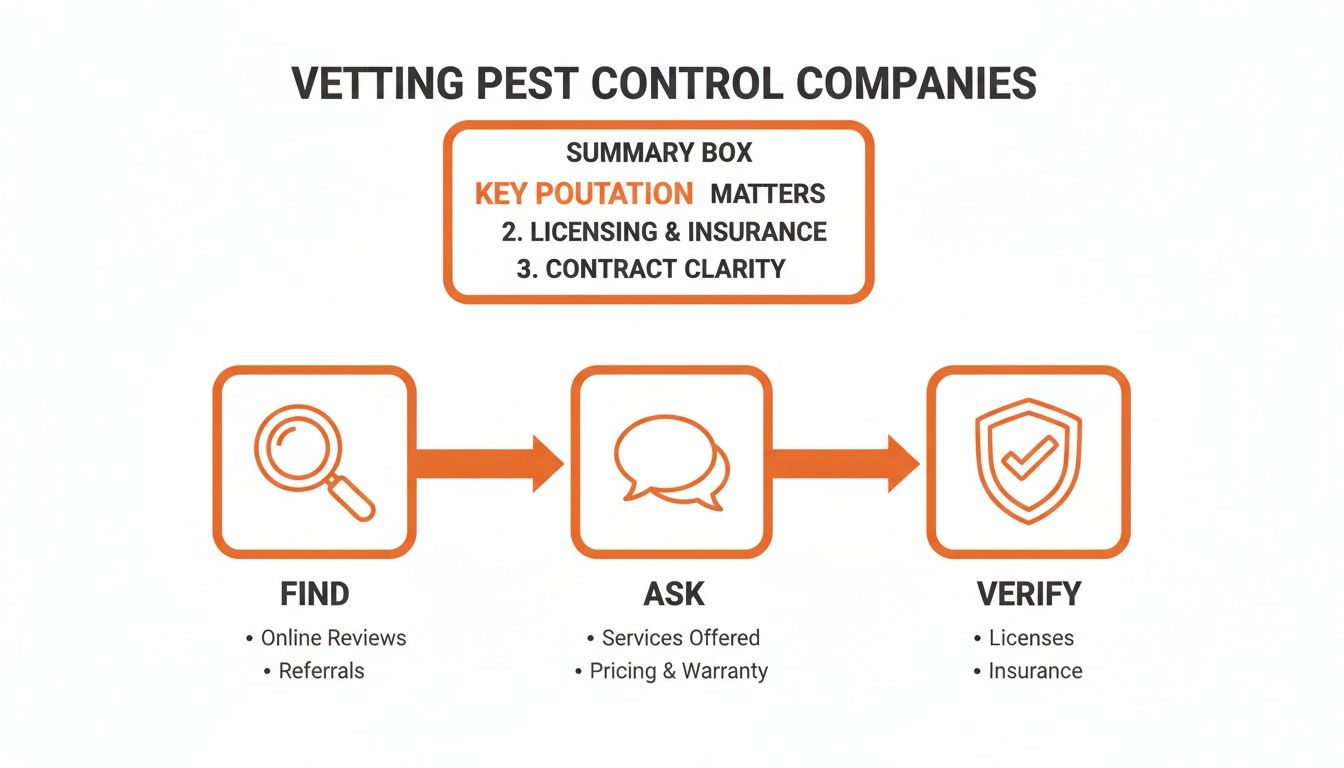
Stick to that Find, Ask, Verify process. It’s your best defense against wasting time and money on unqualified companies.
Deconstructing the Treatment Plan
A good quote is more than a number—it’s a detailed battle plan. A vague, one-line estimate is a sign of an amateur. A real professional proposal from a licensed pest control company will break everything down so you know exactly what you're paying for.
Here’s what you should demand to see:
- Pest Identification: It needs to clearly state what pest they found and where they found it. "Ants" isn't enough; "Odorous House Ants in kitchen pantry" is.
- Treatment Method: Will they use baits, liquids, traps, or exclusion? A detailed plan shows they've actually thought about your specific problem.
- Products Used: The plan should list the specific products they'll use, including brand names. You have a right to know what's being applied in your home.
- Scope of Work: It should outline exactly which areas will be treated—the kitchen, the foundation, the attic, etc.
This level of detail is standard practice in the United States, where over 34,000 licensed businesses make up a $17.4 billion industry. With residential services accounting for 70% of that revenue, homeowners are driving the demand for effective, well-documented solutions. You can see the full breakdown of these trends by reading the research on pest control market growth.
Comparing Value Beyond Price
Let’s look at two real-world scenarios side-by-side. This is where you can really see the difference between a cheap fix and a real solution.
| Feature | Quote A (Low-Cost, Vague) | Quote B (Detailed IPM Plan) |
|---|---|---|
| Price | $150 | $350 |
| Treatment | "General pest spray for ants" | "Targeted gel bait for Odorous House Ants in kitchen, liquid barrier at exterior foundation" |
| Follow-Up | None mentioned | One follow-up visit scheduled for 30 days post-treatment |
| Guarantee | "Satisfaction guaranteed" (no specifics) | "90-day guarantee with free re-treatment if ant activity returns" |
Quote A looks tempting at $150, but what are you actually getting? A generic spray and a meaningless guarantee. Quote B is more expensive, but it tells you the exact pest, the strategy, the follow-up plan, and backs it with a specific promise. That's value. For a deeper dive into what things should cost, check out our guide on the cost of pest control services.
A higher-priced, detailed quote from a licensed company isn't an upsell—it's a reflection of a comprehensive solution. It covers professional-grade products, the technician's time and expertise, and the assurance of a job done right.
If a quote feels too good to be true or is missing key details, trust your gut. A reputable company will always provide a written, detailed plan without you having to ask. For a second opinion on confusing quotes, Call +1 855 224 3071 anytime.
What to Expect During and After the Service
Lots of people think pest control is just a person showing up to spray some chemicals around the baseboards. It's so much more than that. Knowing what a real professional service looks like helps you spot the difference between a cheap "splash-and-dash" job and a company that will actually solve your problem.
When you hire one of the best licensed pest control companies, their work starts the second they step out of the truck. They shouldn't just grab a sprayer and get to it. A true pro acts like a detective. They'll start with a thorough inspection, asking you exactly what you've seen, where you've seen it, and for how long. They'll be looking for entry points, nests, droppings, and other subtle signs of activity you might have missed.
This initial walkthrough is non-negotiable. It’s where they confirm what pest you're dealing with, figure out how bad the infestation is, and finalize their game plan. They should walk you through what they're going to do, what products they’ll use, and any safety precautions you, your family, or your pets need to follow. If anything feels unclear, or you just have questions, don't be afraid to Call +1 855 224 3071 for clarification.
During the Treatment
Once you give them the green light, the actual service begins. A good technician works methodically, treating the specific areas they identified during the inspection—not just mindlessly spraying everything. One of the clearest signs of a professional is their attention to detail and how carefully they treat your home.
Here’s what a quality service visit should look like:
- Targeted Application: Treatments are applied precisely where pests hide, travel, and breed. Think cracks, crevices, wall voids, and nesting sites, not just a random coating on your floors.
- Clear Communication: They should tell you which areas to avoid and for how long. This is especially critical if you have kids or pets running around.
- Professional Conduct: The technician should arrive in a uniform, carry clear identification, and be able to confidently answer your questions about the process or the products being used.
A licensed pro isn't just there to kill the bugs you can see. Their real goal is to break the pest's life cycle and put measures in place to stop them from coming back.
After the treatment is done, the technician should circle back with you. They'll recap what they did, tell you what to expect over the next few days (sometimes you'll see more pest activity at first as they're flushed out of hiding), and explain any follow-up steps you need to take.
After the Service Concludes
The job isn't over when the truck pulls away. A professional pest control service always includes proper follow-up and documentation. Any reputable licensed pest control company will provide you with a detailed service report.
This document is your official record of the work performed. At a minimum, it should list:
- The date and time the service was completed.
- The name of the technician who did the work.
- A list of the specific pests that were targeted.
- The names and EPA registration numbers of all products that were applied.
- Notes on any follow-up appointments or ongoing monitoring plans.
Finally, when it comes time to pay, it helps to understand the difference between an invoice and a receipt to keep your records straight. Having all the proper paperwork is part of what separates the pros from the amateurs. If you have any questions after the service or need to book a follow-up, Call +1 855 224 3071 to get in touch with your provider.
Answering Your Top Pest Control Questions
You've got questions, and when it comes to hiring someone to treat your home, getting straight answers is non-negotiable. We've compiled some of the most common things homeowners ask when looking for licensed pest control companies.
How Can I Quickly Verify a Pest Control License?
The single fastest and most reliable way is to go straight to the source: your state's Department of Agriculture or official licensing board website.
These government sites almost always have a public, searchable database. You can usually plug in a company's name or the license number they gave you and see their status in real-time.
A reputable company will never hesitate to give you their license number—many even link to their public record right on their website. If a company gets defensive or vague about this, it’s a major red flag.
Need immediate help checking a provider's credentials? You can always Call +1 855 224 3071 for assistance.
Are 'Green' Pest Control Services Really Effective?
Absolutely, but only when they're done by a true, licensed professional.
Real "green" pest control isn't just about using a certain spray. It's a whole strategy called Integrated Pest Management (IPM). This approach is all about prevention first, using targeted, low-toxicity products only as a last resort.
A licensed technician has the training to know how and when to apply these methods. It’s a sophisticated process that eliminates pests while keeping your family and pets safe. Be very skeptical of any unlicensed handyman who throws around the word "green" as a marketing buzzword without the credentials to prove it.
What’s the Difference Between a License and a Certification?
This is a great question and a common point of confusion. Here’s a simple way to think about it:
A license is the mandatory permit from the state. It proves the company meets the bare minimum legal requirements for insurance, safety, and basic operational knowledge. You should never hire a company without one.
A certification is voluntary and shows a technician has gone above and beyond to get advanced, specialized training. Certifications often focus on specific, tough problems like termite colony elimination, bed bug heat treatments, or complex wildlife removal.
While a license is essential, seeing certifications is a strong signal that you’re dealing with a top-tier company committed to mastering their craft.
Why Do Licensed Companies Cost More Than Unlicensed Ones?
That higher price tag from a licensed pest control company isn't just for profit—it’s buying you critical protection and peace of mind. The cost directly covers the things that separate a professional from a risk.
An unlicensed operator’s low price means you are the one accepting all the risks they’ve decided to skip—from having no insurance for damages to using the wrong chemicals in your home.
Here's what that professional quote actually pays for:
- Liability Insurance: Protects your property from accidental damage during a service.
- Workers' Compensation: Protects you from liability if a technician gets hurt on your property.
- Proper Training & Education: Keeps technicians current on the safest, most effective treatment protocols.
- Professional-Grade Equipment: Ensures they have the right tools to diagnose and solve the problem correctly the first time.
When you get a quote that seems a bit higher, what you're really paying for is accountability. For a transparent, no-obligation quote from a vetted and licensed pro, Call +1 855 224 3071 today.
For a fast, reliable connection to a pre-screened, licensed exterminator in your area, trust Pest Control Service Finder. Our network of professionals is ready to handle your pest issues safely and effectively. Reclaim your home with confidence by visiting https://pestcontrol-service-finder.com.